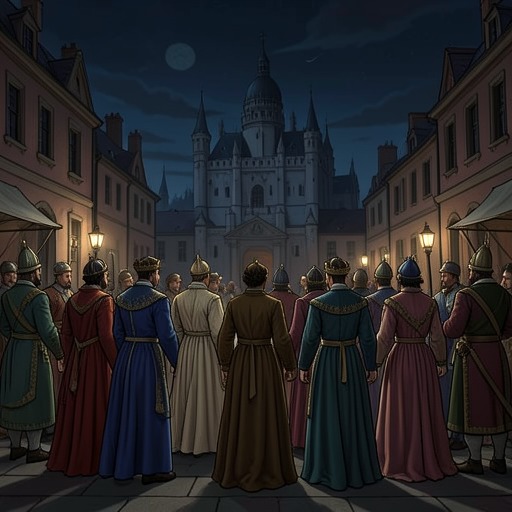
Anvard
The Horse and His BoyAnvard is King Lune’s castle in Archenland and the strategic gateway in Rabadash’s plan to extend Calormene power into Narnia. The attempted capture makes the castle a military objective, but its defense also brings Shasta to King Lune and reveals the law and succession that shape Archenland’s rule.
Strategic Importance
Rabadash proposes crossing the desert with two hundred horsemen and reaching Anvard before its defenders can prepare. He intends to seize the castle, then ride through the pass into Narnia and onward to Cair Paravel. In his scheme, Anvard is not merely a stop along the route: holding it would give Calormen a permanent position at Narnia’s gate, from which its garrison could be enlarged over time.
Rabadash frames the operation as a way to advance without binding the Tisroc to an open war. If it fails, his father could disavow the expedition as an unauthorized act driven by his son’s impulsiveness. The plan therefore treats Anvard as both a military prize and a means of disguising responsibility for an invasion.
Warning and Assault
The attack puts the castle’s peaceful status at the heart of the conflict. As Rabadash’s force approaches, the Hermit of the Southern March tells Shasta that the enemy is finding a ford over the Winding Arrow and that King Lune must be warned. Shasta reaches the king and reports what he has seen: Rabadash and two hundred horsemen are approaching Anvard. His warning gives the castle’s defenders notice of the danger.
When Rabadash is captured, he demands to be released so that he can fight King Edmund. King Lune refuses to treat this as an honorable challenge. Because Rabadash attacked Anvard during peacetime without first sending a defiance, Lune calls him a traitor rather than a knight and orders him bound and taken into the castle. The attempted assault thus ends not in a sanctioned duel but in the capture of the attacker.
Law, Kingship, and Aftermath
King Lune later offers to free Rabadash unharmed under conditions, citing both the law of nations and prudent policy. Rabadash rejects the offer while still in chains, insisting that he will not hear conditions unless he is given a sword. The exchange contrasts his appeal to personal force with Lune’s effort to govern the aftermath through law.
Anvard is also the setting for the revelation that Shasta is Cor, the king’s elder son and heir. Lune tells him that the crown comes to him under the law; when Cor objects that he would rather not displace Corin, the king explains that a king cannot simply set the law aside. Cor is older than Corin by twenty minutes, and that difference determines the succession. The castle’s defense and its household succession therefore converge: Anvard is not only a fortress to be captured or defended, but the seat of a lawful order that constrains both an invading prince and its own king.